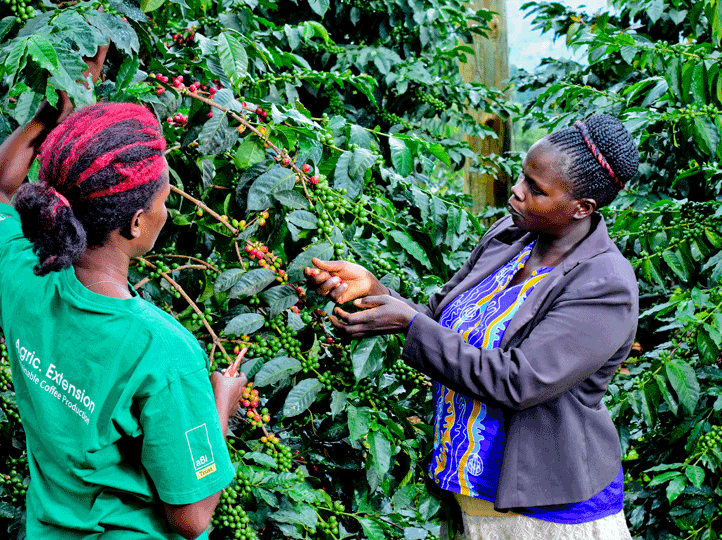
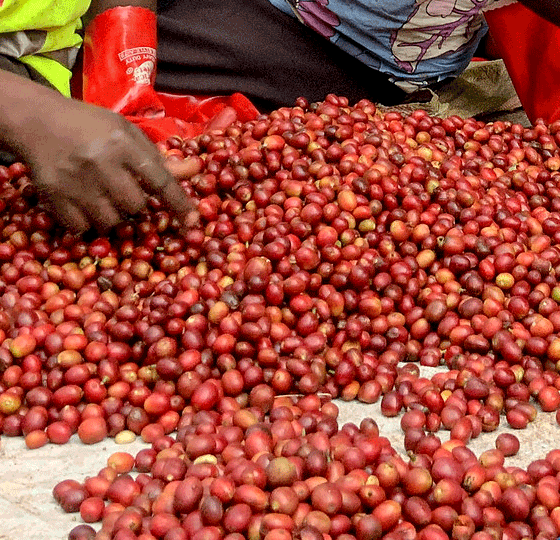
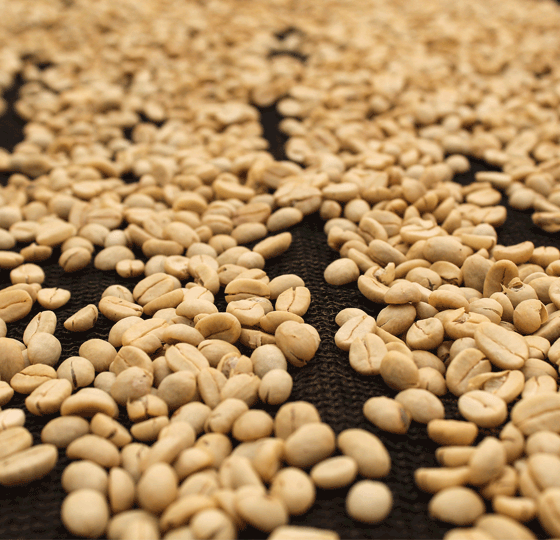
Bukonzo Organic Farmers Co-operative Union was started in 2009 to try to increase the prices gained by farmers for their coffee production. This region of SW Uganda has historically been made up of home processed and natural coffees of lower commercial qualities. Recognising the excellent growing conditions for arabica production, Bukonzo invested in 36 local micro washing stations designed to process high quality fully washed coffees, as well as securing organic certification for their farmers. This approach has allowed an increase in premiums reaching the farmers in what is one of the most impoverished parts of the country, creating a sustainable industry for which they can provide for their families. Bukonzo also place a large emphasis on environmental sustainability, using organic fertilisers from local livestock and intercropping with bananas, beans, fruit trees, coco-yams, vanilla, passionfruit, and mango trees.
The Swiss Water® Process uses pure green coffee extract and proprietary carbon technology to remove caffeine from green coffee beans. Swiss Water® has specified the pore size of the carbon to match the caffeine molecule to ensure only the caffeine is trapped when the caffeine is captured from the green coffee extract.
Country of Origin
Uganda
Harvest Season
2022/23
Coffee Grade
UGA CA FW SPL
Bag Type
Grain Pro / Ecotact
Plant Species
Arabica
Processing
Washed
Variety
SL14, SL28, Nyasaland
Region
Rwenzori
Co-Op
Bukonzo Organic Farmers Co-operative Union
Farm Name
Various smallholders
Certifications
FLO Fairtrade Certified, Organic certified
History of Coffee in Uganda
While the commercial cultivation of coffee is defined by geopolitical boundaries, the wild coffees of East Africa do not recognize borders. Indigenous Robusta once grew wild in such abundance in DR Congo that “Congo” was at one time the nickname for all Robusta, no matter where it was grown; but the moniker could just as easily have been Uganda, where Robusta is also indigenous and still grows wild in the region around Lake Victoria. Commercial cultivation began early in the 20th century and grew quickly. Only 250 bags were exported in 1909. By 1918, exports had reached 75,000 bags. Like coffee in much of post-colonial Africa, coffee production in Uganda struggled with disease, disruption, and dictatorship for the last half of the 20th century, but exports have been relatively stable in recent decades and Arabica production has increased. In 2020, coffee exports exceeded 5 million bags for the first time.
Growing Coffee in Uganda
In Uganda, most coffee is often grown under shade and intercropped with banana, beans, and peanuts in highland regions in volcanic soils. Traditionally, smallholders grow on less than 2.5 hectares, using natural processing to dry coffee cherries in very small spaces around their homes. Gradually, semi-washed processing has been introduced and some fully-washed coffees have become available recently.