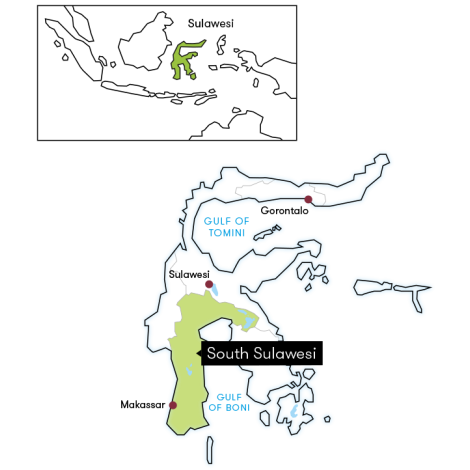
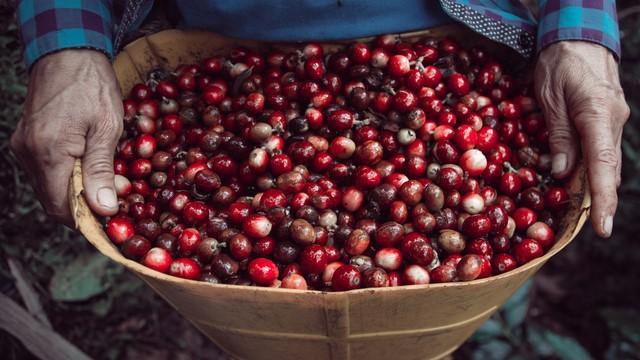
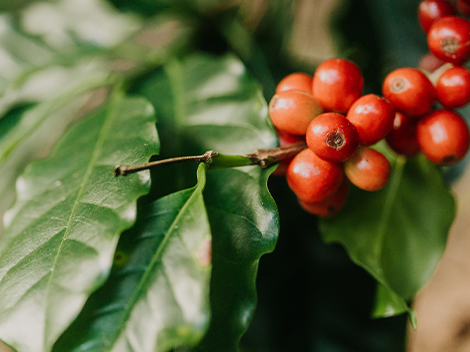
This triple-picked, wet-hulled lot is sourced from smallholder farmers in the highlands of South and West Sulawesi, in the Mamasa, Toraja, and Enrekang regions. Harvests here are generally acquired by collectors who circulate amongst the farming regions, buying depulped and partially dried seeds directly from farms and conveying them to mills, where the drying process is completed, the parchment is sorted for quality and then milled for export.
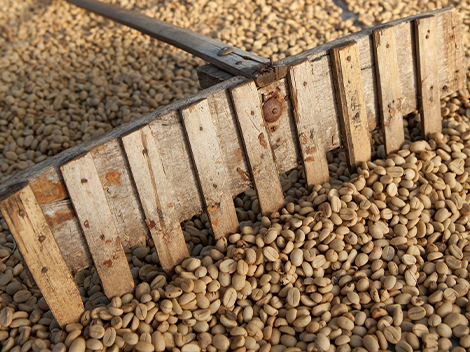
Wet hulling is a process devised in Sumatra and adopted throughout the region as a solution to rainy, humid conditions that make drying green coffee a challenge. Typically, farmers depulp freshly picked cherries, ferment overnight, and wash the seeds before selling to a mill or collector only partially dried. The coffee's husk (parchment) is removed much earlier stage than in a standard washed process, while the green seed is still soft and pliable; great care is needed to prevent excessive damage. After milling, the coffee seeds are then finally dried until optimum moisture content is reached.
Country of Origin
Indonesia
Region
Mamasa, Toraja and Enrekang, Sulawesi
Producer Type
Small Holder Farmers
Farm Name
Various producers
Processing
Wet Hulled
Growing Altitude
1100m - 1900m
Harvest Season
2023/24
Bag Weight
60 KG BAG
Bag Type
Grain Pro / Ecotact
Plant Species
Arabica
Variety
Ateng, S. Lini
History of Coffee in Sulawesi
Although coffee was first planted successfully on Java around 1700, cultivation spread slowly throughout what would become the great archipelagic state of Indonesia, and did not arrive on Sulawesi, then called Celebes, until 1750, after the coffee of Java had performed its role as progenitor to the coffees of Central America and begun its ascent to being considered, alongside Arabian Mocha, as one of the best coffees in the world. Somewhat parenthetically, it should be noted that nearly all coffee from any island in the Dutch East Indies (Indonesia) was considered “Java” until the early 20th century, so Celebes/Sulawesi has no real history on the consumption side of coffee prior to that time.
Growing Coffee in Sulawesi
For a long time, Sulawesi was little more than a footnote as far as the coffee trade was concerned, but with the emergence of the specialty coffee industry, this coffee, grown at higher altitudes than most Indonesian coffee, gained more attention and with more attention came improvements in processing and refinement to wet-hulling. Today, Sulawesi coffees deliver the good body and herbal notes expected from Indonesian coffee, but also some unexpected brightness and fruit.